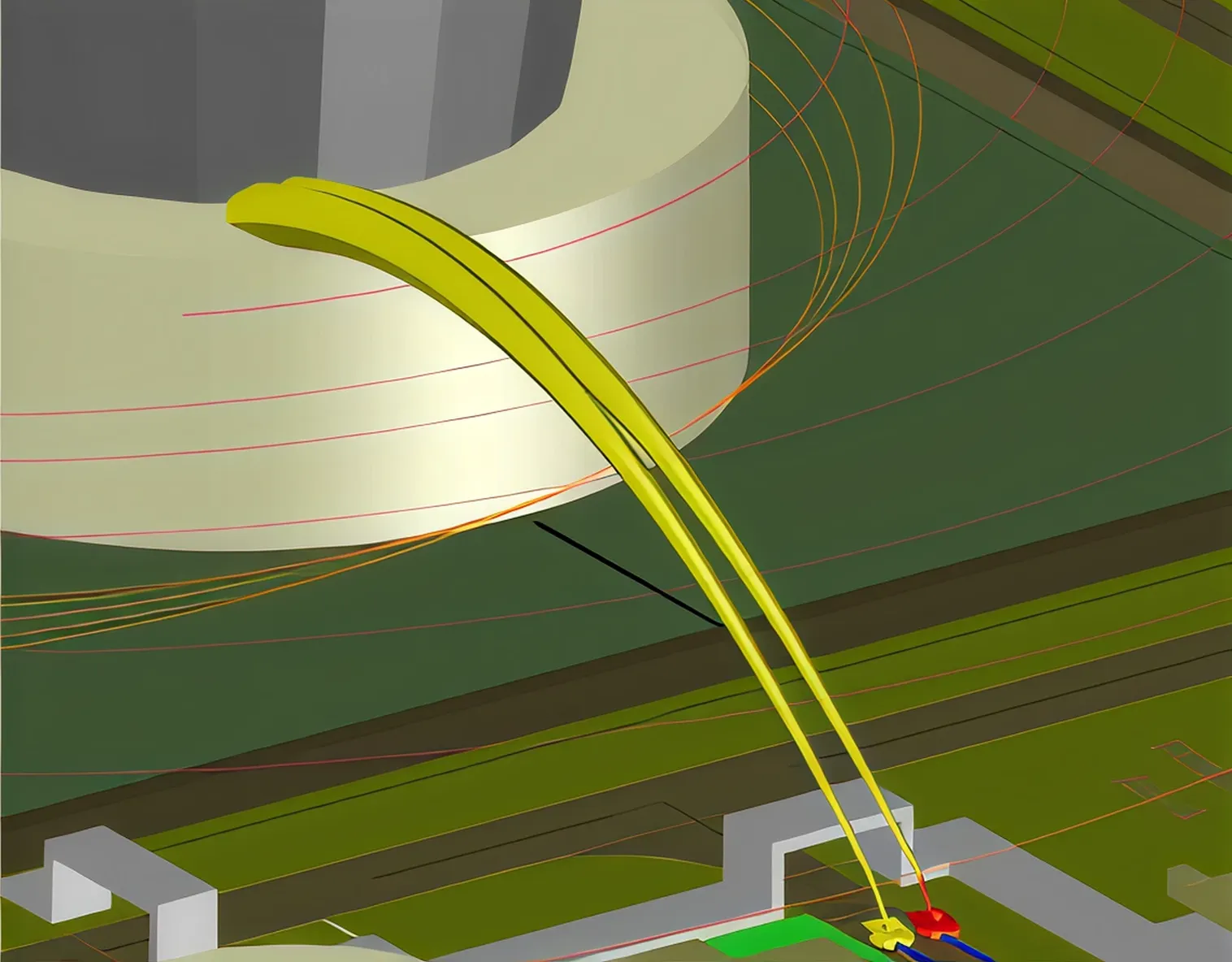

This software was developed to simulate the trajectory of water discharged from a water nozzle and the trajectory of foam discharged from a foam nozzle. In particular, for water discharge, it can simulate not only a straight stream of water but also the trajectory at any spray angle. By using this water/foam discharge simulation software, it is possible to consider the appropriate placement of chemical fire trucks, ladder trucks, water cannons, water cannons, foam monitors, etc., during a fire in windy conditions.
Use the 3D viewer to make simulation results more "realistic".
By using the dedicated "FM Viewer," you can freely manipulate the simulation results on your PC. You can pinpoint and zoom in on the area you want to see, dramatically improving your understanding of the analysis accuracy compared to conventional still images.
Services offered: Tank fire extinguishing / Radiant heat calculation / Water and foam discharge
Further details are explained on the FM Viewer introduction page.
The radial trajectory differs depending on the type of water nozzle. Our program uses two or more radial trajectory data points from the nozzle manufacturer to determine characteristic factors specific to our program, allowing us to reproduce a flight path that is appropriate for that nozzle.
Compatible nozzles
remarks
VariableWater nozzle
Portable nozzles, water cannons, water cannons, water cannons mounted on fire trucks, aerial water cannons, etc.
jetnozzle
Portable nozzles, etc.
Water curtain nozzle
Types that spray high-pressure water straight up to form a water curtain, etc.
spray nozzle
It can handle a wide variety of situations. Radiation patterns can be simulated at any angle, not just directly above, to the side, or directly below. It can also check whether the spray system provides sufficient protection in windy conditions.
sprinklernozzle
Typically, the trajectory of projectiles fired directly upwards and downwards is simulated to determine the protected area.
⚠Please note that this product is not compatible with flat spray nozzles.
Water discharge pattern
In addition to jet sprays, it can also simulate radial trajectories at any spray angle (0-120°).
Wind effects
It can simulate radial trajectories that reflect the effects of wind blowing at any angle, not just tailwinds or headwinds.
Water discharge direction
You can simulate water discharge at any angle. In the case of a water curtain nozzle, you can consider the height that can be reached by spraying water straight up = water curtain height.
This tool displays radial trajectories on top of AutoCAD drawings such as plant layouts and maps. While typically displayed in three dimensions, two-dimensional display is also possible.
Water radiation simulation example
Example 1: Water cannons with a fixed spray angle changed
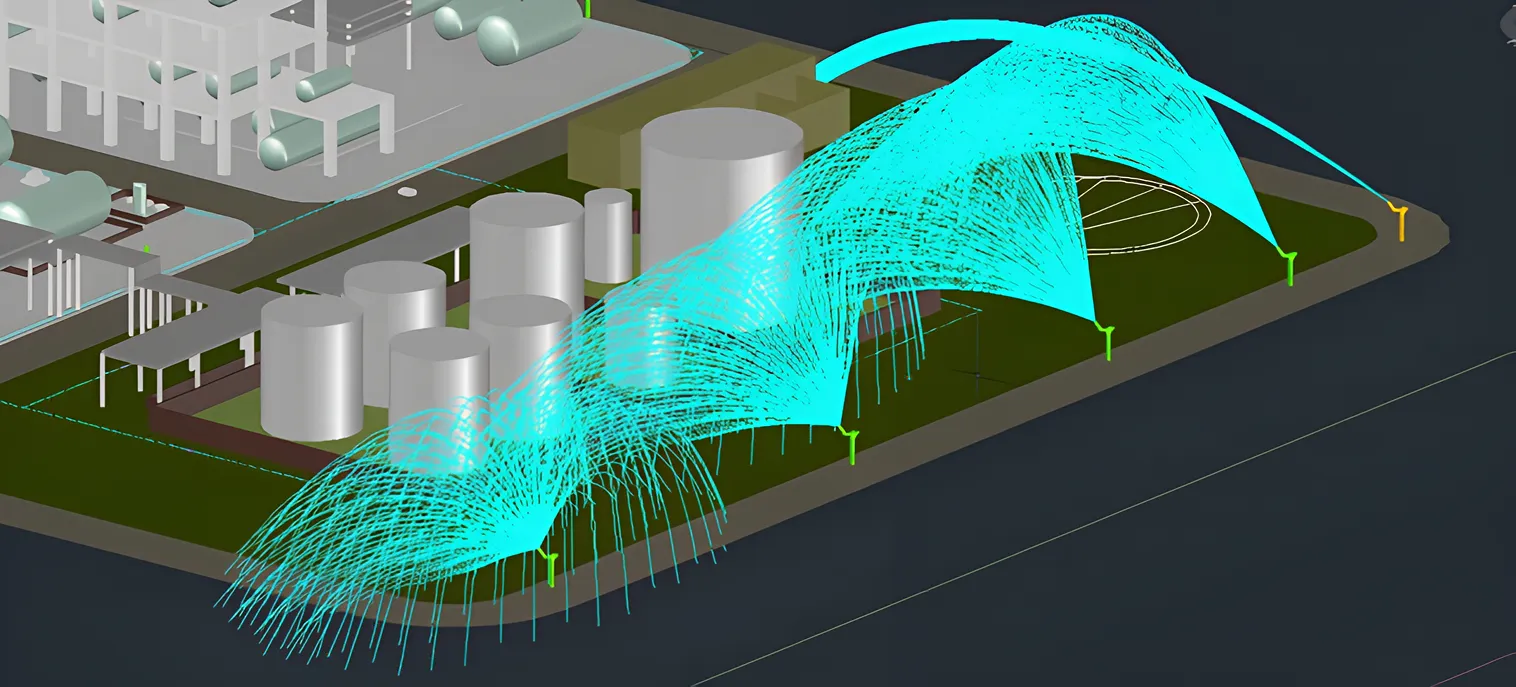
The diagram below shows the water discharge pattern when the spray angle is changed from a fixed water cannon, simulating spray angles of 0 degrees, 30 degrees, 60 degrees, 90 degrees, and 120 degrees from right to left.
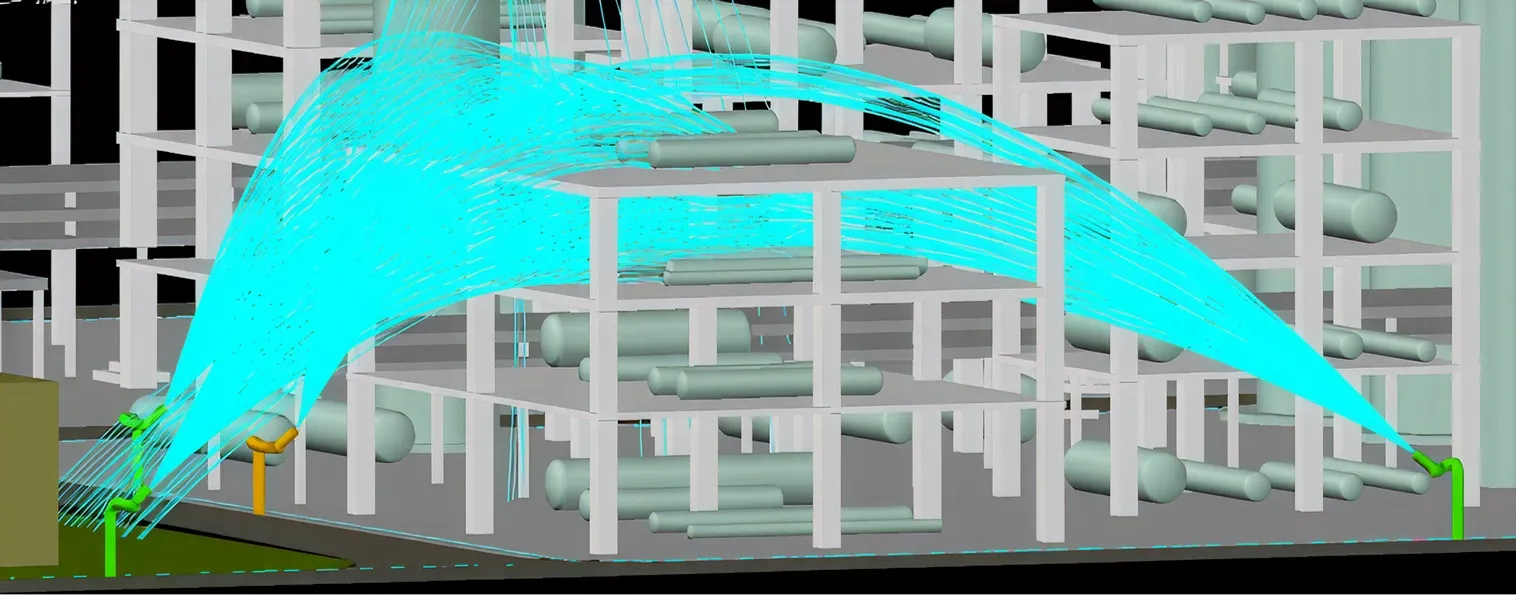
Example 2: Water cannons simultaneously sprayed from both upwind and downwind sides.
The diagram below shows an example of water being sprayed onto equipment on a structure. Because the spray angle is set to 30 degrees, it is strongly affected by the wind, and the water sprayed against the wind does not travel very far. However, the water sprayed with a tailwind travels a sufficient distance, indicating that overall it can provide adequate coverage even in windy conditions.
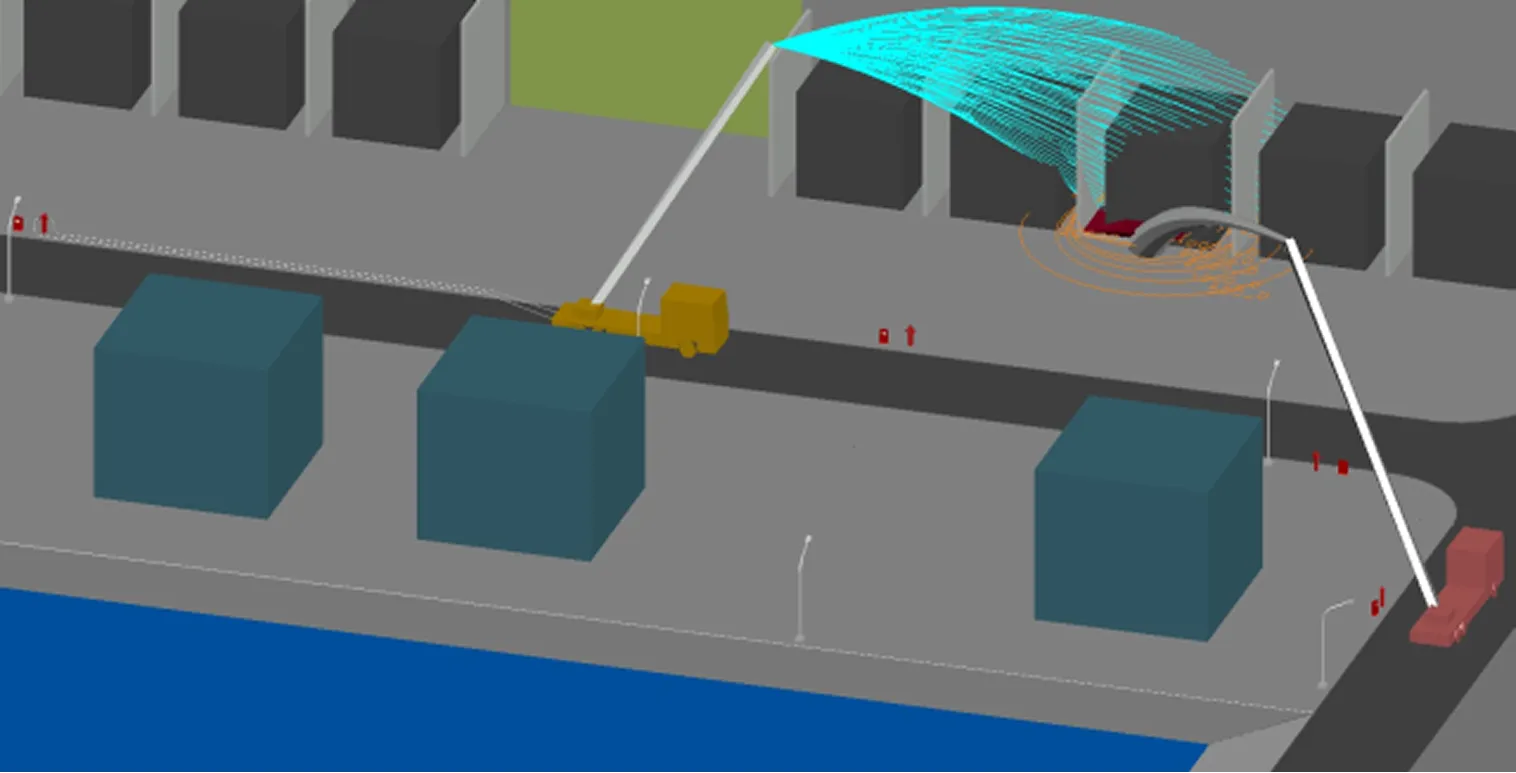
Example 3: Water is sprayed onto a power plant transformer from a fire truck (ladder truck).
The diagram below shows firefighting efforts during a transformer fire, with foam being sprayed from the fire truck on the right.
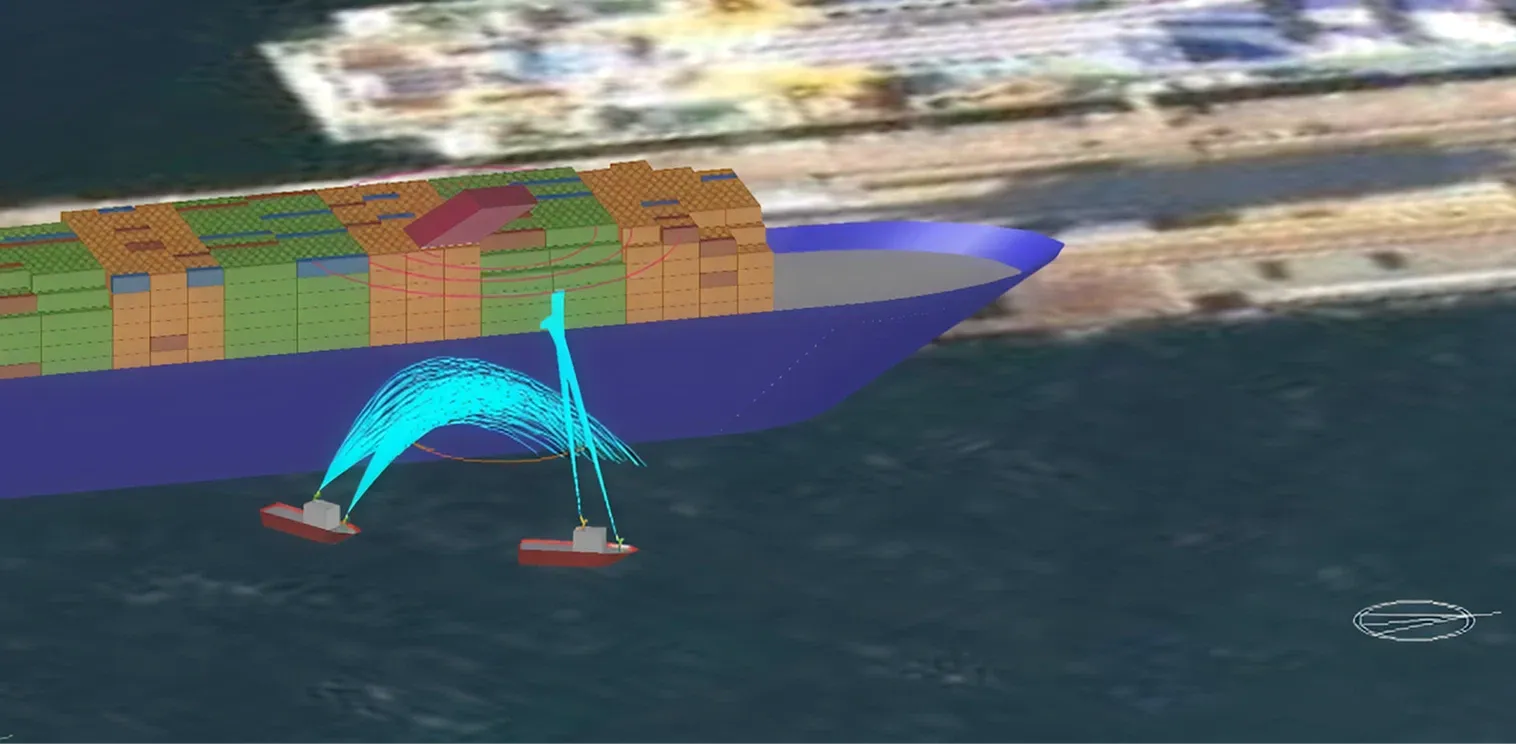
Example 4: Water cannons fired from a fireboat at a container ship
As shown in the diagram below, by using various three-dimensional sketches (layouts, etc.), it is possible to consider various water discharge activities depending on the situation.
Foam discharge
Compatible nozzles
The radiation trajectory differs depending on the type of foam nozzle. Our program uses two or more radiation trajectory data points from the nozzle manufacturer to determine characteristic factors specific to our program, allowing us to reproduce a flight trajectory that is appropriate for that particular nozzle.
Compatible nozzles
remarks
Aspirator nozzle
This nozzle draws in air at the nozzle base, then foams it up into bubbles approximately seven times its original volume (expansion ratio) and sends them flying. Examples include portable foam nozzles, foam cannons, foam monitors mounted on fire trucks, and foam monitors on ladder trucks.
Non-aspirator nozzle
The nozzle sprays a foamy aqueous solution, and as it flies, it draws in air, gradually increasing in volume and forming bubbles. The foaming ratio is low, around 2 to 3. Portable foam nozzles, foam cannons, foam monitors mounted on fire trucks, foam monitors on ladder trucks, etc.
Expansion ratio
In the case of an aspirator nozzle, the expansion ratio remains constant during flight, but in the case of a non-aspirator nozzle, the expansion ratio changes depending on the flight time, so the expansion ratio at the time of landing must be calculated.
Water discharge pattern
It only supports rod-shaped radiation.
Wind effects
It can simulate radial trajectories that reflect the effects of wind blowing at any angle, not just tailwinds or headwinds.
Radial direction
You can simulate radiation at any angle.
display
This tool displays radial trajectories on top of AutoCAD drawings such as plant layouts and maps. While typically displayed in three dimensions, two-dimensional display is also possible.
Examples of foam emission simulation
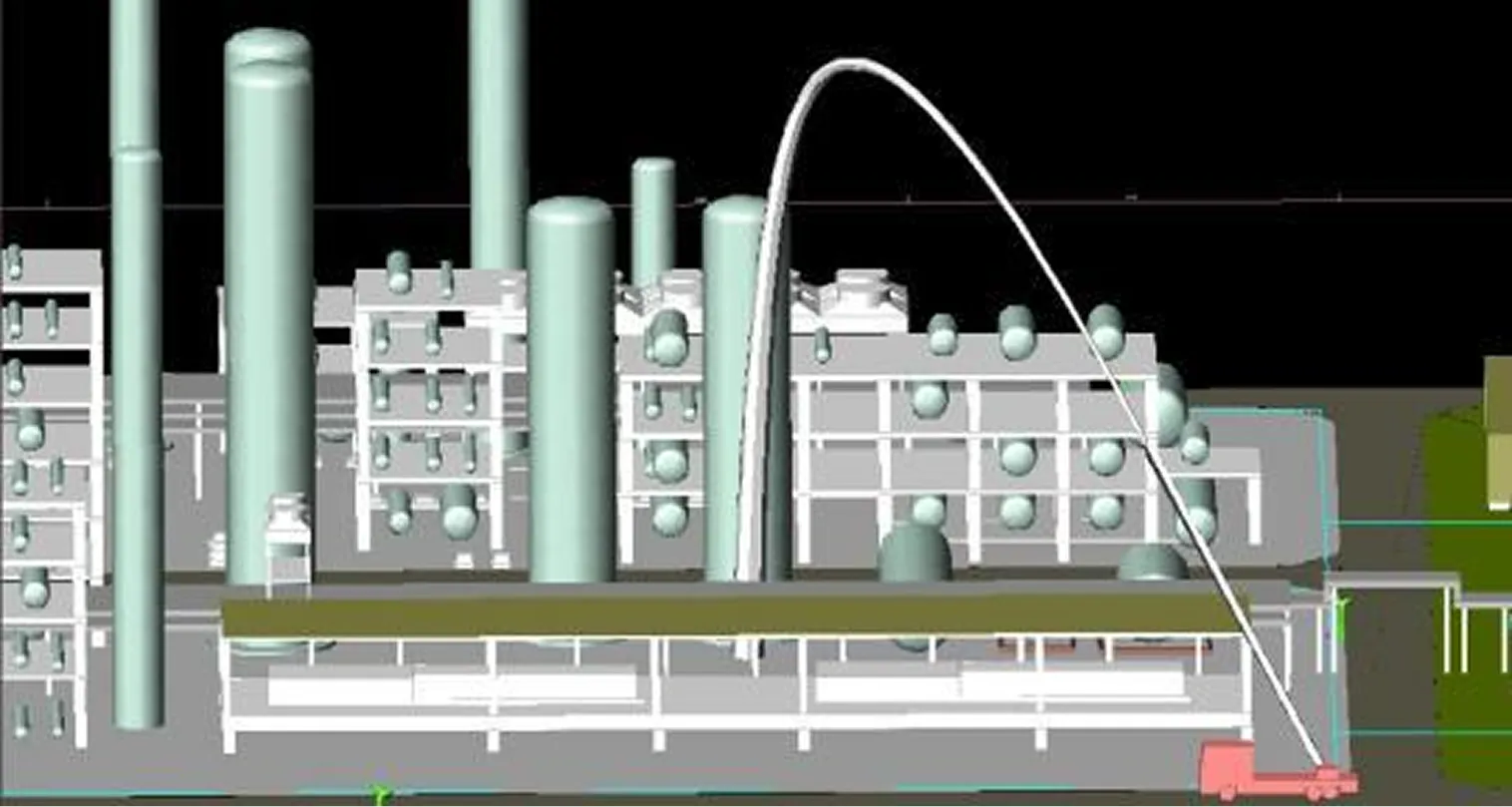
Example 1: Foam discharge from a fire truck during a process area fire
The diagram below shows an example of foam being sprayed from a fire truck over a compressor shelter during a process area fire.
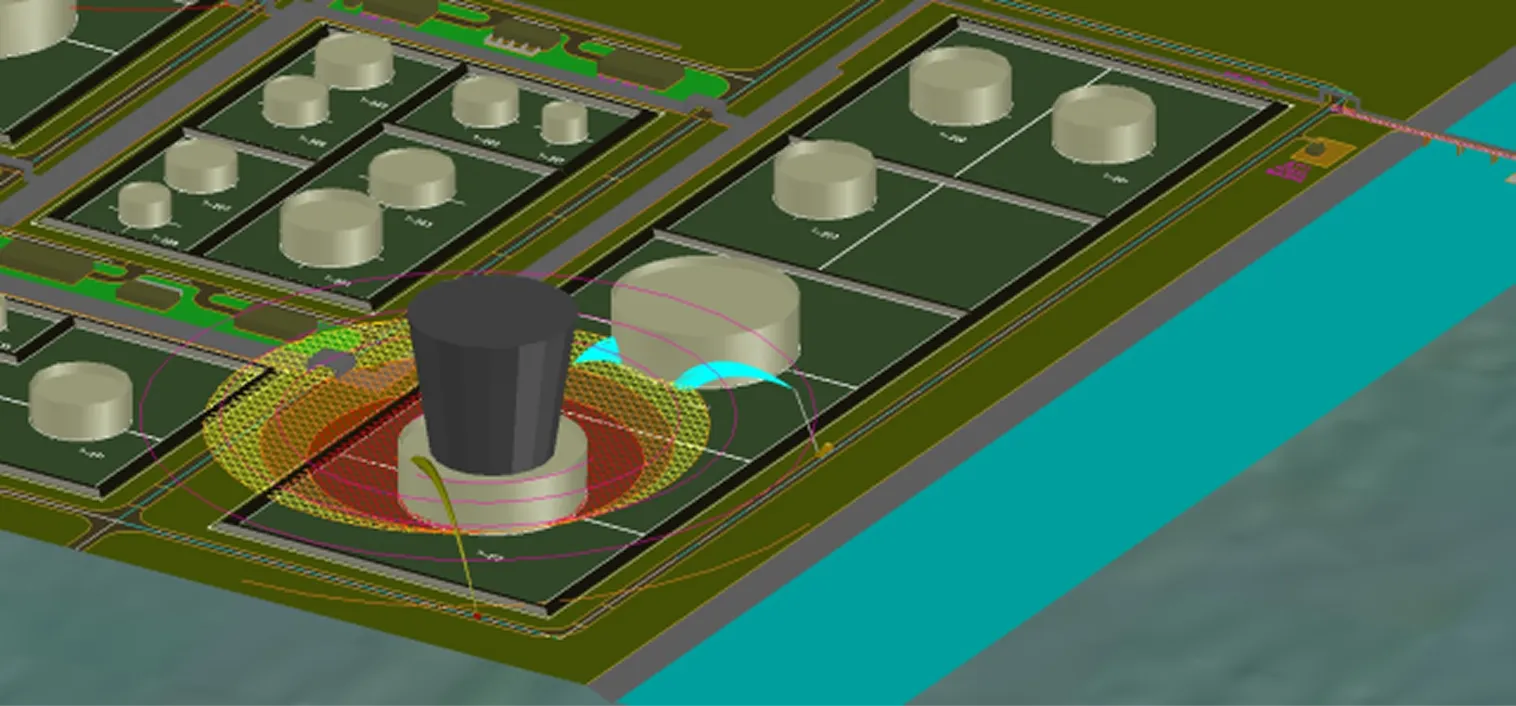
Example 2: Foam spraying from a fire truck to a tank fire
The black cylinder on the tank in the diagram below represents the area with the largest updraft caused by the fire. The foam discharge must be directed to avoid this area and enter the tank. If done correctly, the foam discharge will be golden in color.
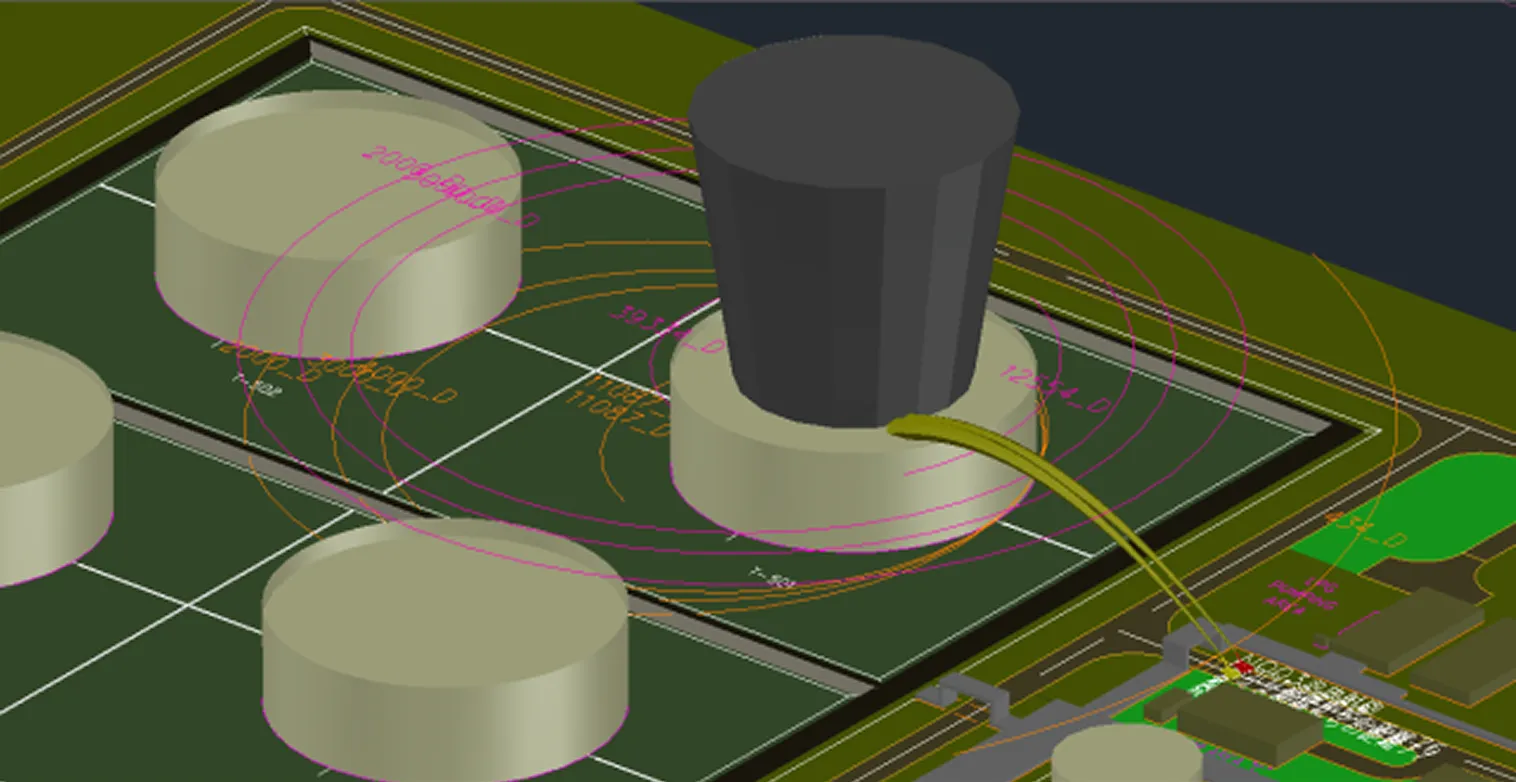
Example 3: Foam spraying to tank fires using a large-capacity foam spraying monitor
The diagram below shows an example of foam being sprayed from a large-capacity foam cannon towards a tank over a pipe rack. The black cylinder on top of the tank represents the area with the largest updraft due to the fire.
The image below is a close-up of the pipe rack. It is necessary to display a 3D layout of structures that could potentially cause radiation interference in the preliminary drawing.